

For wound care specialists, topical medications are fundamental to patient care, but they represent a significant source of billing complexity and revenue loss. The application of these agents is often incorrectly bundled into other services, and the supplies themselves are scrutinized under varying payer policies. Navigating the intricate rules surrounding CPT®, HCPCS, modifiers, and medical necessity is no longer optional—it is essential for financial viability and regulatory compliance. Getting this wrong leads to denied claims, costly audits, and compromised revenue streams.
Navigating CPT® Codes for Application & Debridement
A common misconception is that a specific CPT® code exists for the simple application of a topical medication. In most cases, the application is considered an integral part of the Evaluation and Management (E/M) service or another primary procedure being performed. However, when the application is tied to a more significant procedure like debridement, specific codes come into play.
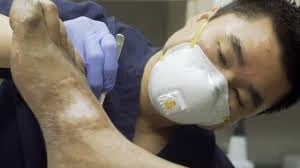
For instance, CPT® codes 97597 (Debridement...first 20 sq cm or less) and +97598 (each additional 20 sq cm) include the application of topical agents directly related to the debridement process. The key to reimbursement is meticulous documentation that details the wound's size, depth, the type of tissue removed, and the medical necessity for the procedure. Billing for a separate E/M service on the same day requires appending modifier -25 and proving that a significant, separately identifiable service was performed beyond the debridement itself.
HCPCS Codes and Modifiers: The Keys to Supply Reimbursement
While CPT® codes cover the physician's work, HCPCS Level II codes are used to bill for the actual topical medications and dressings. These codes, often found in the A-codes (e.g., A6231 for a hydrogel dressing) or Q-codes (e.g., Q4101 for Apligraf), are where payer policy variation is most extreme. Many payers, including Medicare Administrative Contractors (MACs), publish Local Coverage Determinations (LCDs) that specify which products are covered and for which diagnoses.
Successfully billing for these supplies requires a direct and defensible link between the ICD-10 diagnosis code and the HCPCS code. Furthermore, modifiers like -59 (Distinct Procedural Service) or the more specific XE, XS, XP, and XU modifiers may be necessary to differentiate services that are not normally reported together. For example, if multiple distinct wounds are treated with different products, these modifiers are critical for signaling this to the payer and preventing improper bundling denials.
Clinical Scenario: Tying It All Together
Consider a 68-year-old patient with type 2 diabetes presenting with a 15 sq cm necrotic ulcer on the right heel. The provider performs a significant E/M service to manage the patient's overall vascular and glycemic status, then proceeds with sharp selective debridement of the wound and applies a silver-impregnated hydrogel dressing.
The claim should be coded as follows:
- ICD-10: L97.413 (Non-pressure chronic ulcer of right heel and midfoot with necrosis of muscle), E11.621 (Type 2 diabetes mellitus with foot ulcer).
- CPT®: 99213-25 (Office visit, established patient, with modifier -25 indicating a significant, separate E/M service).
- CPT®: 97597 (Debridement, for the first 20 sq cm).
- HCPCS: An appropriate A-code for the silver hydrogel dressing, such as A6242.
In this scenario, the -25 modifier is crucial for the E/M payment, and the specific ICD-10 codes establish the medical necessity for both the debridement (97597) and the advanced dressing (A6242). Without this level of precision, the claim would likely face denials for bundling and lack of medical necessity.
Achieving Coding Precision and Financial Health
Securing proper reimbursement for topical medications in wound care is not about finding loopholes; it's about demonstrating clinical necessity through coding precision. Accurate billing requires a synergistic approach: detailed clinical documentation, correct application of CPT® and HCPCS codes, strategic use of modifiers, and a robust understanding of ever-changing payer policies. By mastering these elements, wound care practices can protect their revenue, ensure compliance, and continue providing critical services to their patients. Staying ahead of regulatory shifts, especially those anticipated for 2025-2026, requires dedicated expertise.
Topical Billing Essentials
- Bundling is Standard: Application of topicals is often included in the E/M or primary procedure code.
- Supplies are Separate: Use HCPCS Level II codes (A-codes, Q-codes) to bill for the actual products.
- Modifiers are Crucial: Use modifier -25 for separate E/M services and -59/X-modifiers for distinct procedures to prevent denials.
- Prove Medical Necessity: Link specific ICD-10 codes to every CPT® and HCPCS code on the claim.
- Verify Payer Policy: Always check LCDs and commercial payer policies, as coverage varies significantly.
Why Choose Us
Bonfire Revenue's specialists thrive on the complexities of wound care billing. We manage your credentialing, perform coding audits, and fight denials to secure every dollar you've earned. Our proactive approach to 2025-2026 regulations ensures your practice remains compliant and profitable, allowing you to focus entirely on patient outcomes.