

Rural Health Clinics (RHCs) are on the front lines of addressing the nation's mental health crisis, yet they face unique reimbursement challenges that can impede care delivery. As patient demand for behavioral health integration grows, so does the complexity of navigating payer-specific policies and evolving coding guidelines. Mastering the nuances of mental health billing is no longer just an administrative task; it is a critical component of financial stability and sustainable patient access for rural providers. This article provides a technical framework for accurate coding to ensure your clinic captures every dollar earned.
Core CPT Codes for Psychotherapy Services
Accurate reimbursement for mental health services begins with selecting the correct Current Procedural Terminology (CPT) code based on documented time. The most common outpatient psychotherapy codes are time-dependent and require meticulous record-keeping of the face-to-face (or telehealth) time spent with the patient.
Key codes include:
- 90832: Psychotherapy, 30 minutes (must be 16-37 minutes).
- 90834: Psychotherapy, 45 minutes (must be 38-52 minutes).
- 90837: Psychotherapy, 60 minutes (must be 53 minutes or longer).
Documentation must include start and stop times to withstand payer audits. For urgent situations, CPT add-on code +90839 (Psychotherapy for crisis; first 60 minutes) can be billed with a primary psychotherapy service, but its use is highly scrutinized and requires documentation justifying the crisis state.
Navigating Modifiers and Place of Service (POS)
Modifiers are essential for providing context to payers and preventing claim denials, especially when multiple services are rendered. In a rural setting where a patient might see their primary care provider for a medical issue and receive mental health counseling in the same visit, Modifier 25 is critical. It signifies a "Significant, Separately Identifiable Evaluation and Management Service by the Same Physician or Other Qualified Health Care Professional on the Same Day of the Procedure or Other Service." It must be appended to the E/M code (e.g., 99213, 99214) to ensure both services are reimbursed.
With the expansion of telehealth, correct modifier and POS usage is paramount. Modifier 95 should be appended to the CPT code to indicate the service was delivered via synchronous telemedicine. This must be paired with the correct POS code—typically POS 10 (Telehealth Provided in Patient’s Home) or POS 02 (Telehealth Other Than in Patient’s Home)—to align with payer requirements, which can vary significantly. Failure to align these elements is a common cause of denials.
ICD-10 and Payer Policy Alignment: A Case Study
The link between the service provided (CPT) and the reason for the service (ICD-10) must be irrefutable. Payers use Local Coverage Determinations (LCDs) to define which diagnosis codes support medical necessity for specific procedures. A vague or mismatched diagnosis can trigger an immediate denial.
Real-World Example: A patient with established hypertension (I10) visits your clinic for a blood pressure check and also reports escalating symptoms of anxiety following a recent family event. The provider performs a problem-focused exam for the hypertension (5 minutes) and then conducts a 28-minute psychotherapy session to address coping strategies for the patient's diagnosed Generalized Anxiety Disorder (F41.1).
- E/M Service: 99212-25
- Psychotherapy Service: 90832
- ICD-10 Linking: I10 is linked to 99212. F41.1 is linked to 90832.
In this scenario, Modifier 25 is essential because two distinct services were performed. The documentation must clearly separate the E/M portion from the psychotherapy session. The specific ICD-10 codes not only justify each service individually but also demonstrate a comprehensive approach to patient care that payers will recognize and reimburse.
Securing Your Clinic's Financial Health
For Rural Health Clinics, financial viability is directly tied to billing precision. Integrating mental health services requires a deep understanding of time-based CPT codes, strategic use of modifiers like 25 and 95, and rigorous ICD-10-to-CPT code linking. By focusing on detailed documentation and staying current with payer-specific LCDs, your clinic can overcome common billing hurdles, reduce denials, and ensure the long-term sustainability of these essential services. Proactive RCM management is the cornerstone of serving your community effectively.
Mental Health Billing Essentials
- Use time-based CPTs (90832, 90834, 90837) with precise start/stop time documentation.
- Apply Modifier 25 to E/M codes when a separate psychotherapy service is performed on the same day.
- For telehealth, use Modifier 95 and the correct Place of Service code (e.g., POS 10).
- Ensure specific ICD-10 codes directly support the medical necessity for each CPT code billed.
Why Choose Bonfire Revenue
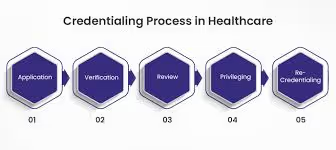
Rural clinics face unique RCM challenges. Our consultants specialize in navigating complex payer policies, credentialing providers for mental health services, and optimizing your billing cycle. We ensure you're prepared for 2025-2026 regulatory changes, protecting your revenue so you can focus on patient care.