

The financial health of a modern dental practice is directly tied to coding and billing accuracy, particularly for high-value restorative procedures. While treatments like crowns, bridges, and fillings are routine, the behind-the-scenes process of securing reimbursement is increasingly complex. Payers scrutinize claims for restorative dentistry, frequently denying services that lack clear medical necessity or proper code linkage. A simple mismatch between a CDT procedure code and an ICD-10 diagnosis code can trigger an immediate rejection, leading to payment delays, increased administrative burden, and significant revenue loss. This guide provides actionable strategies for navigating these billing nuances to ensure your practice is compensated fully and promptly for the essential care you provide.
Navigating Core CDT Codes for Restorative Procedures
Precision in restorative coding begins with selecting the correct Current Dental Terminology (CDT) code. Generic or incorrect code selection is a primary reason for claim denial. It is critical to differentiate codes based on material, number of surfaces, and procedure complexity.
Key considerations include:
- Direct Restorations: For posterior composites, accurately document the number of surfaces to distinguish between D2391 (1 surface) and D2393 (3 surfaces). Under-coding surfaces leaves earned revenue on the table.
- Indirect Restorations: Differentiate crowns by material, as reimbursement varies significantly. A D2740 (Porcelain/Ceramic Crown) is distinct from a D2750 (Crown - Porcelain Fused to High Noble Metal). Mismatching the code with the clinical reality can lead to audits.
- Supporting Procedures: The code for a core buildup, D2950 (Core buildup, including any pins), is one of the most frequently denied codes. Payers often bundle it with the crown procedure unless clinical necessity for a separate restoration is explicitly proven. Documentation must clearly state that the buildup was required to provide adequate retention and support for the crown, independent of the crown preparation itself.
The Critical Link: ICD-10 Diagnosis and Documentation
A CDT code explains *what* you did; the ICD-10-CM diagnosis code explains *why* you did it. This link is the foundation of establishing medical necessity. Payers are increasingly denying claims that use unspecified diagnosis codes or show a weak clinical justification for the procedure performed. For example, submitting a claim for a crown (D2740) with a diagnosis of unspecified dental caries (K02.9) is a red flag for auditors.
To fortify your claims, you must pair procedures with highly specific diagnoses. A crown is better supported by K03.81 (Cracked tooth) or K02.63 (Dental caries on smooth surface penetrating into dentin). For a core buildup (D2950), the diagnosis must justify the extensive loss of tooth structure. While the CDT code set does not use modifiers in the same way as medical CPT codes, the use of a detailed narrative in Box 35 of the ADA claim form serves the same purpose. This narrative must concisely explain the clinical rationale, such as, "Core buildup required for crown retention due to fracture and loss of over 50% of coronal tooth structure."
Case Study: Billing for a Crown with Core Buildup
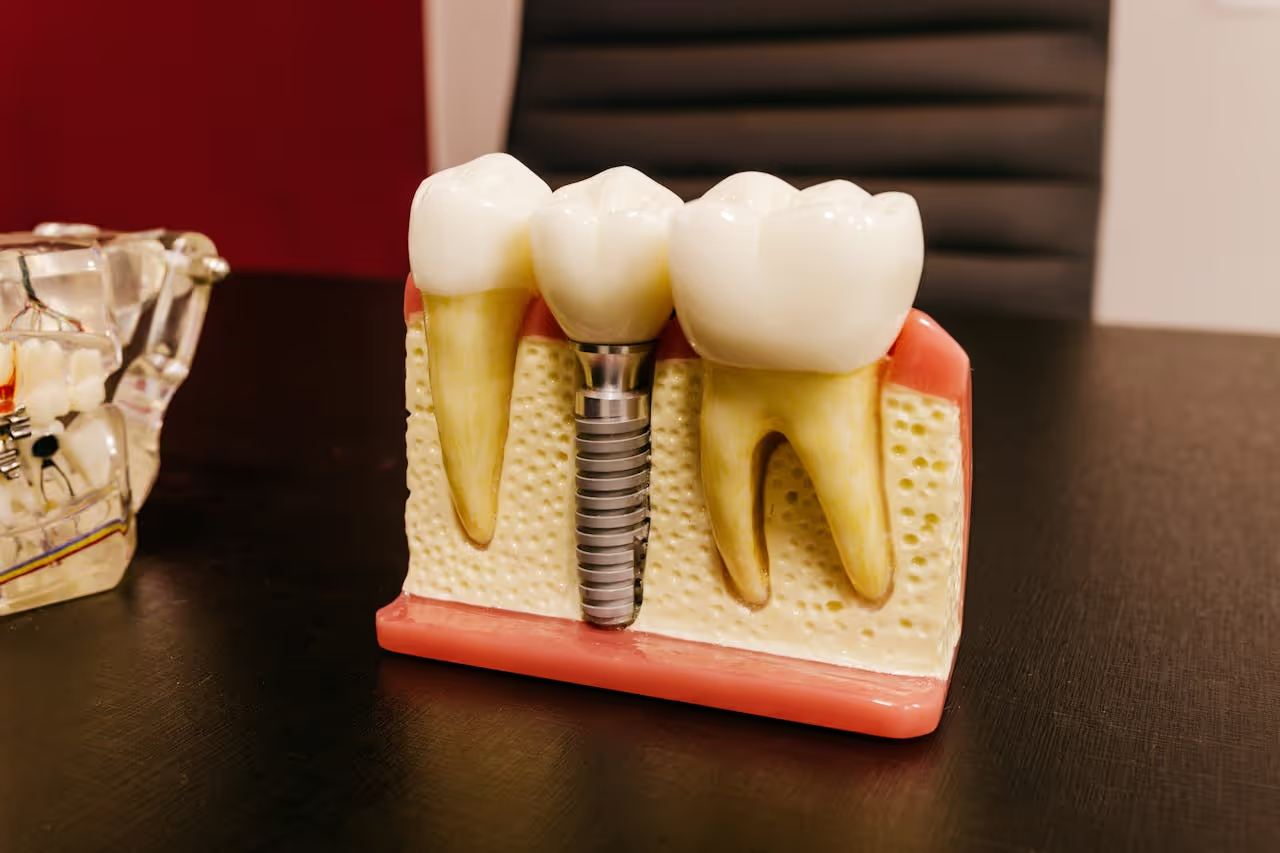
Consider a common scenario: a patient requires a crown on tooth #14 due to a large, fractured amalgam filling and recurrent decay. The remaining tooth structure is insufficient to support a new crown.
Incorrect Billing Approach:
- CDT Codes: D2740, D2950
- ICD-10 Code: K02.9 (Dental caries, unspecified)
- Result: The payer denies D2950 as "inclusive to the crown preparation" and may request additional information for the crown, delaying payment.
Correct Billing Approach:
- CDT Codes: D2950, D2740
- ICD-10 Codes: K03.81 (Cracked tooth) as primary, K02.63 (Dental caries... penetrating into dentin) as secondary.
- Narrative for D2950: "Clinically necessary core buildup for prosthesis retention. Over 60% of coronal tooth structure was missing post-caries excavation and fracture removal, leaving insufficient structure for crown support."
- Result: This claim creates a clear, defensible clinical picture. It justifies the medical necessity for both procedures as distinct and necessary, overcoming the common bundling denial and securing appropriate reimbursement.
Driving Revenue Through Coding Precision
Mastering restorative dental billing is not about memorizing codes; it's about building a narrative of clinical necessity supported by data. Every element of the claim—from the CDT code and ICD-10 diagnosis to the supporting documentation and narrative—must align to tell a clear and compelling story. By focusing on specificity, justifying each procedure independently, and understanding payer policies, your practice can significantly reduce denials, accelerate cash flow, and protect its revenue. Proactive revenue cycle management, grounded in coding excellence, is the key to thriving in the evolving 2025-2026 regulatory landscape.
Restorative Coding Essentials
- Match Specificity: Pair specific CDT codes with equally specific ICD-10 diagnoses to prove medical necessity.
- Justify Buildups: Always document the clinical rationale for core buildups (D2950) to prove they are not inclusive to the crown prep.
- Narratives are Crucial: Use detailed narratives for complex cases to preemptively answer payer questions and prevent denials.
- Code by Material: Differentiate crown codes (e.g., D2740 vs. D2750) based on the final material used, as reimbursement rates vary.
Why Choose Us
Common denials for core buildups and crowns are preventable revenue leaks. At Bonfire Revenue, our dedicated dental RCM consultants understand the payer-specific policies and evolving 2025-2026 regulations that impact your bottom line. We go beyond simple claim submission to ensure your documentation supports every code, maximizing reimbursement and minimizing audit risk.