

Physician Assistants (PAs) are integral to modern hospital care, delivering high-quality services in both inpatient and emergency department (ED) settings. However, the expanding scope of practice for PAs is often met with complex and unforgiving billing regulations. Standard "incident-to" billing rules do not apply in the hospital environment, creating significant reimbursement challenges. This guide will dissect the specific coding and billing nuances PAs must master to ensure accurate payment, maintain compliance, and reflect the true value of the care they provide.
Navigating Inpatient Billing: Beyond 'Incident-To'
A common point of confusion for practices is the application of "incident-to" billing. In the hospital inpatient setting (Place of Service 21), "incident-to" billing is not permitted. All services rendered by a PA must be billed under the PA’s own National Provider Identifier (NPI). For Medicare, this means services are reimbursed at 85% of the physician fee schedule. Attempting to bill PA services under a supervising physician’s NPI in this setting is a direct compliance risk that will lead to audits and takebacks.
Accurate coding for initial and subsequent hospital care is paramount. PAs must use the appropriate Evaluation and Management (E/M) CPT codes, such as Initial Hospital Care (99221-99223) and Subsequent Hospital Care (99231-99233). The level of service billed must be meticulously supported by documentation that clearly details the complexity of Medical Decision Making (MDM) or, for some payers, total time. Without robust documentation justifying the code selection, downcoding and denials are inevitable.
Coding Accuracy in the Emergency Department
In the Emergency Department (Place of Service 23), billing rules for PAs also require precision. While PAs typically bill under their own NPI, split/shared visit rules can apply if a physician provides a substantive portion of the E/M visit face-to-face. However, for services performed independently, the PA is the billing provider. The ED E/M codes (99281-99285) are selected based on the three key components of MDM: the number and complexity of problems addressed, the amount and/or complexity of data to be reviewed and analyzed, and the risk of complications and/or morbidity or mortality of patient management.
A critical tool in the ED is Modifier 25, used to report a significant, separately identifiable E/M service by the same provider on the same day of a procedure. For example, if a PA evaluates a patient for a deep laceration (E/M service) and then performs the suture repair (a procedure), Modifier 25 should be appended to the E/M code to allow for separate reimbursement. Proper use requires distinct documentation for the E/M portion of the visit, separate from the procedure note.
Clinical Scenario: Coding Acute Abdominal Pain
Consider a PA in the ED evaluating a 42-year-old male with severe right lower quadrant pain, fever, and nausea. The PA performs a detailed history and exam, orders a CBC and a CT scan of the abdomen, and reviews the results. The MDM is high due to a new problem with uncertain prognosis (e.g., appendicitis vs. diverticulitis) and the decision to admit for surgical consultation.
The coding would be:
- E/M Service: CPT 99285 (Emergency department visit for the evaluation and management of a patient, which requires a medically appropriate history and/or examination and high level of medical decision making).
- Diagnosis: The primary diagnosis would be R10.31 (Right lower quadrant pain), which establishes medical necessity for the workup. Once the CT confirms appendicitis, the diagnosis would be updated to K35.80 (Unspecified acute appendicitis).
In this scenario, the high-level MDM directly supports the 99285 code. If the patient is then admitted by the PA, the PA would also bill for the Initial Hospital Care (e.g., 99222), as the ED service and admission service are distinct. This demonstrates how precise documentation and correct code linkage are essential for capturing the full scope of work performed.
Recap: Mastering PA Hospital Billing
Maximizing reimbursement for PA services in hospital and ED settings hinges on a deep understanding of payer-specific rules and coding fundamentals. Key takeaways include abandoning "incident-to" logic for inpatient services, billing under the PA's NPI, and ensuring documentation rigorously supports the level of E/M service. Correctly applying modifiers like 25 and linking precise ICD-10 codes to CPT codes are not just best practices—they are requirements for financial stability. By focusing on coding accuracy and compliance, PAs and their practices can overcome common billing nuances and secure the revenue they have rightfully earned.
PA Billing Essentials
- 'Incident-to' billing does not apply in hospital inpatient or outpatient settings (POS 21, 22, 23).
- PAs must bill under their own NPI, typically reimbursed at 85% of the physician fee schedule by Medicare.
- Documentation must robustly support the E/M level (e.g., 99221-99223 for inpatient, 99281-99285 for ED) based on MDM.
- Use Modifier 25 for significant, separately identifiable E/M services performed with a minor procedure on the same day.
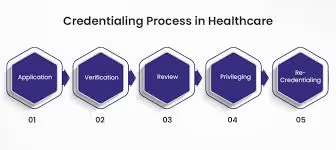
- Ensure the PA is properly credentialed with the facility and all major payers to avoid claim denials.
Why Choose Us
Navigating PA billing rules is complex and time-consuming. At Bonfire Revenue, our experts specialize in RCM for PAs, from credentialing to complex coding scenarios. We eliminate the guesswork, reduce denials, and optimize your revenue cycle so you can focus on patient care.