

Osteopathic Physicians (D.O.s) provide a distinct, whole-person approach to medicine, particularly valuable in orthopedic evaluations where musculoskeletal diagnosis is intertwined with hands-on treatment. This integrated care model, however, presents unique revenue cycle challenges. Payers frequently scrutinize claims that bundle Evaluation and Management (E/M) services with Osteopathic Manipulative Treatment (OMT), leading to denials if not coded with absolute precision. Mastering the nuances of CPT, ICD-10, and modifier application is not just best practice; it is essential for capturing appropriate reimbursement and ensuring the financial health of your practice.
Differentiating E/M Services and OMT Procedures
The foundational element of accurate billing is clearly distinguishing the cognitive E/M service from the procedural OMT service. The E/M component (CPT codes 99202-99215) is justified by the complexity of Medical Decision Making (MDM) or total time spent, encompassing the patient history, examination, and formulation of a differential diagnosis and treatment plan. This is the "thinking" part of the visit.
Conversely, OMT (CPT codes 98925-98929) is a distinct hands-on procedure. Reimbursement for these codes is determined by the number of body regions treated, not the time spent. For example, 98925 covers 1-2 body regions, while 98929 covers 9-10. Documentation must explicitly list the specific somatic dysfunctions treated in each region to support the code selection and establish medical necessity. Failure to separate these two service components in your documentation is a direct path to a claim denial.
The Critical Role of Modifier 25 in Combined Services
When an E/M service and an OMT procedure are performed during the same encounter, appending Modifier 25 to the E/M code is mandatory. This modifier signals to the payer that the E/M service was a "significant, separately identifiable" service from the usual pre-operative and post-operative care associated with the OMT. Without it, payers will almost certainly bundle the E/M service into the OMT procedure, resulting in non-payment for the evaluation component.
Justifying the use of Modifier 25 requires robust documentation. The note must clearly show that the E/M service went above and beyond the standard assessment inherent to performing OMT. This could involve managing a new problem, addressing a significant exacerbation of a chronic condition, or performing a comprehensive evaluation that leads to the decision to perform OMT. Your documentation should tell a clear story: a distinct evaluation was performed, leading to a diagnosis that necessitated a separate, hands-on treatment procedure.
Coding Scenario: ICD-10 Specificity and Payer Policies
Consider a real-world scenario: An established patient presents with acute, severe, right-sided low back pain radiating into the buttock following a lifting injury. The evaluation includes a detailed history of the incident, a thorough musculoskeletal exam, and MDM involving prescription of an NSAID and discussion of activity modification. This work justifies CPT code 99214. Following the evaluation, you perform OMT on the lumbar, sacral, and pelvic regions. This procedural work is captured by CPT code 98926 (3-4 body regions treated).
The claim should be submitted as:
- 99214-25
- 98926
The ICD-10 codes must support both services. You would link a diagnostic code like M54.50 (Low back pain, unspecified) to the 99214, but for the OMT, you must link to codes for somatic dysfunction, such as M99.03 (Somatic dysfunction of lumbar region) and M99.04 (Somatic dysfunction of sacral region). This level of specificity is crucial. Furthermore, be aware of payer-specific Local Coverage Determinations (LCDs) from carriers like Medicare, which may limit the number of OMT sessions allowed for an acute condition, requiring vigilant tracking and documentation of functional improvement.
Securing Your Revenue Cycle
For Osteopathic Physicians, financial success is directly tied to coding precision. Effectively billing for orthopedic evaluations requires a clear delineation between E/M and OMT services in your documentation, the consistent and appropriate use of Modifier 25, and linking each service to highly specific ICD-10 codes that prove medical necessity. By adopting a proactive and detailed approach to coding and staying current with evolving payer regulations, you can overcome common billing hurdles, reduce denials, and ensure you are fully reimbursed for the comprehensive, high-value care you provide.
Orthopedic D.O. Billing
Separate E/M & OMT: Document the cognitive work (E/M) distinctly from the hands-on procedure (OMT).
Use Modifier 25: Always append Modifier 25 to the E/M code when performing OMT in the same session to signify a separate, significant service.
ICD-10 Specificity: Link E/M to the patient's condition (e.g., M54.50) and OMT to the specific somatic dysfunction treated (e.g., M99.03).
Check Payer Rules: Be aware of payer-specific policies and LCDs that may limit OMT frequency or require proof of functional improvement.
Why Choose Us
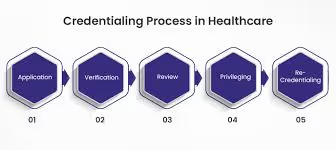
Navigating D.O.-specific billing complexities is our specialty. Bonfire Revenue's experts understand the nuances of E/M and OMT coding, modifier application, and payer regulations. We manage your entire revenue cycle, from credentialing to claim submission and denial management, ensuring your practice is compliant and profitable. Stop letting incorrect coding compromise your revenue.