

Oral and Maxillofacial Surgery (OMS) occupies a unique and complex space in healthcare, straddling the line between dental and medical services. This duality creates significant billing and coding challenges that can directly impact your practice's revenue cycle. A routine extraction may be a straightforward dental claim, but a complex, medically necessary procedure resulting from trauma requires navigating the intricate world of medical CPT and ICD-10 codes. Mastering these nuances is not just about compliance; it's about ensuring fair reimbursement for the high-value, specialized care you provide.
Navigating the Medical vs. Dental Billing Divide
The primary challenge for an OMS practice is determining the correct payer. The decision to bill medical versus dental insurance hinges on the "why" behind the procedure—the diagnosis and medical necessity. Procedures treating disease, injury, or congenital defects, such as cyst excisions, fracture repairs, or biopsies of suspicious lesions, are typically covered by medical insurance. Conversely, procedures primarily addressing the teeth and supporting structures without an underlying medical condition, like uncomplicated extractions for orthodontic purposes, fall under dental benefits.
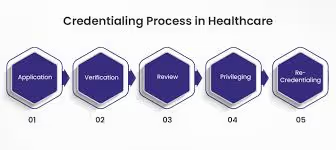
Success in this environment requires proactive provider enrollment and credentialing with both dental and medical payers. Without being a credentialed provider with a patient's medical plan, you forfeit the ability to bill for medically necessary services, forcing you to either write off valid charges or incorrectly bill the patient. This is a critical operational step that directly precedes any successful medical claim submission for OMS procedures.
Essential CPT and ICD-10 Code Compatibility
Accurate reimbursement depends on the logical link between the diagnosis (ICD-10) and the procedure (CPT). The ICD-10 code establishes medical necessity for the CPT code submitted. Payers will deny claims where this relationship is weak or nonsensical.
Consider these common OMS scenarios:
- Impacted Third Molars: For a full bony impaction, billing CPT code 41899 (Unlisted procedure, dentoalveolar structures) to medical insurance is often necessary, especially when CDT code D7240 is not a covered benefit. This must be justified by a clear diagnosis like ICD-10 K01.1 (Impacted teeth) and an operative note detailing the complexity.
- Alveoloplasty with Extractions: When performing alveoloplasty (CPT 41874) with extractions, the diagnosis must support the medical necessity of the bone reshaping. A diagnosis of K08.89 (Other specified disorders of teeth and supporting structures) can justify the procedure beyond the simple extraction.
- Bone Grafts: A major ridge augmentation using a block graft would be reported with CPT 21210 (Graft, bone; nasal, maxillary or malar areas). This requires a strong diagnostic pointer, such as M84.38xA (Stress fracture, other site, initial encounter) for post-traumatic defects or severe atrophy diagnoses.
Leveraging Modifiers and Documenting Complex Cases
Modifiers are essential tools that provide additional context to payers, preventing improper denials for services that might otherwise appear to be bundled or duplicative. Their correct application is critical for OMS, where multiple procedures are often performed in a single encounter.
Real-World Example: A patient requires the extraction of tooth #30 and a separate biopsy of a suspicious lesion on the buccal mucosa during the same visit.
- The extraction is billed to dental with D7210.
- The biopsy is billed to medical with CPT 40808 (Biopsy, vestibule of mouth).
- To prevent the medical payer from bundling the biopsy into the primary procedure, Modifier 59 (Distinct Procedural Service) is appended to 40808. This signals that the biopsy was performed at a separate anatomical site and was not an incidental part of the extraction.
Similarly, Modifier 22 (Increased Procedural Services) can be used for unusually complex procedures, but it must be supported by meticulous documentation in the operative report that quantifies the additional time, effort, and complexity involved.
Achieving Coding Precision and Financial Health
Successfully managing an OMS revenue cycle requires a deep understanding of both dental and medical billing protocols. By correctly identifying the appropriate payer, ensuring strong CPT to ICD-10 linkage to prove medical necessity, strategically applying modifiers like -59, and maintaining robust clinical documentation, your practice can overcome common billing hurdles. This precision not only ensures compliance with evolving 2025-2026 regulations but also secures the financial health and stability of your practice, allowing you to focus on delivering exceptional patient care.
OMS Coding & Billing Essentials
- Dual Credentialing: Being credentialed with medical and dental payers is non-negotiable for maximizing OMS revenue.
- Medical Necessity is Key: The patient's diagnosis (ICD-10) dictates whether a service should be billed to their medical plan.
- Code Linkage: Ensure every CPT code is supported by a specific and appropriate ICD-10 code on the claim form.
- Strategic Modifier Use: Use modifiers like -59 and -22 to accurately represent the services performed and prevent improper bundling denials.
- Documentation: Detailed operative notes are your ultimate defense in an audit and justification for complex procedure coding.
Why Choose Us
Your expertise is in surgery; ours is in securing your reimbursement. Bonfire Revenue specializes in the complexities of Oral and Maxillofacial Surgery billing. We manage the entire RCM process—from medical and dental credentialing to precise coding and relentless claims follow-up—so you can focus on your patients. Let our experts navigate the payer policies and upcoming regulations for you.