
Orthotics Billing: Protecting Your Margins
Fee Schedule Strategy
Many practices undercharge or overcharge when billing for orthotics. Both mistakes cost money—either in lost revenue or triggering payer audits.
- Medicare Fee Schedule as a Baseline: We use your Medicare Administrative Contractor (MAC) as the benchmark for L-code pricing.
- Smart Overcharging: Charging 120–130% of Medicare ensures consistency across payers without raising red flags.
- Secondary Payer Advantage: Overcharging slightly allows secondary insurance to pay its portion correctly.
Example: For L3000 orthotic inserts, we recommend pricing around $490 per unit, balancing compliance with profitability.
Tools We Leverage
- Fair Health (fairhealthconsumer.org) to benchmark ZIP-code specific reimbursements.
- Encoder Pro for integrating Medicare + Fair Health data in one place.
- Supplier Pricing Data to make sure every billed device is profitable.
Our Approach: We bill DME directly for providers rather than you referring them to dispensing suppliers, so your practice captures maximum reimbursement.
Skin Graft Billing: Turning Complexity into Compliance
Billing skin grafts is especially tricky because they’re billed with Q-codes and require exact alignment with National Drug Codes (NDCs).
How We Get It Right
- NDC Crosswalk + ASP Pricing: We pull from CMS files to match graft size with the correct billable units and payment limits.
- Product-Specific Pricing: The same graft (e.g., PuraPly AM) can have very different NDCs and units. We calculate the exact reimbursement before the claim goes out.
- Commercial Plans: We price 120–150% of Medicare’s ASP limit to maximize commercial reimbursements.
Compliance Safeguards
- Chart notes must match graft size and units.
- NDC codes are always included on claims.
- PM/EMR macros connect graft codes to NDCs, saving your staff hours of manual entry.
Working with Suppliers: Avoiding Pitfalls
Not all suppliers are created equal. The wrong supplier leaves you with unpaid invoices and no billing support.
- What we expect: Clear billing guidance, coding assistance, and appeal support.
- What to avoid: “Invoice-only” suppliers who abandon you after the sale.
Our Approach: At Bonfire Revenue, we vet suppliers and align them with billing practices that actually get reimbursed.
Wound Care: Beyond Orthotics and Grafts
- Dressings: Quantity modifiers (A1–A9) add incremental revenue that builds up over time.
- Debridement: Proper depth coding (skin vs. fascia vs. bone) is the difference between a denial and a full payment.
- Add-on Codes: We bundle correctly to avoid compliance risks.
Medicare Part B vs. DME MAC: The Credentialing Divide
One of the most common mistakes is billing the wrong Medicare entity.
- Medicare Part B MAC: Handles professional services and wound care.
- DME MAC: Handles orthotics and DME items. Requires enrollment via the 855S application and potentially a separate NPI for each location.
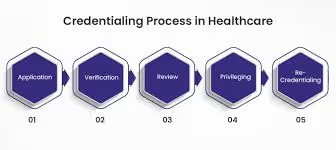
Our Credentialing Edge: Bonfire Revenue manages DME MAC enrollment and ensures your PM/EMR systems are mapped to the correct payer IDs—avoiding costly delays.
Modifiers & Compliance: The Fine Print That Pays
We ensure every claim carries the right modifier the first time.
- NU Modifier: Required by many commercial plans for orthotics.
- LT/RT Modifiers: Splitting charges by side ensures maximum reimbursement.
- 50 Modifier: Used for bilateral procedures but applied differently depending on payer rules.
- GY Modifier: Enables Medicare Part B denials to auto-route to secondary coverage.