

Federally Qualified Health Centers (FQHCs) operate under a unique reimbursement model designed to ensure access to comprehensive care for underserved communities. However, this model, primarily the Prospective Payment System (PPS), introduces significant billing and coding complexities, especially for routine medical office visits. Unlike standard fee-for-service billing, FQHCs must accurately document and code face-to-face encounters not only to trigger the all-inclusive encounter payment but also to provide crucial data for quality reporting and compliance. Missteps in coding can lead to denied claims, compliance risks, and a direct negative impact on the financial health required to sustain your mission. This guide will dissect the essential coding practices for FQHC medical visits, focusing on CPT, modifier, and ICD-10 synergy to overcome common billing hurdles.
Decoding the FQHC Encounter: PPS and T1015
The cornerstone of FQHC reimbursement from Medicare and many Medicaid plans is the all-inclusive encounter rate, billed using HCPCS code T1015 (Clinic visit/encounter, all-inclusive). An "encounter" is a medically necessary, face-to-face visit between a patient and a qualified FQHC practitioner (e.g., physician, NP, PA) for the diagnosis or treatment of an illness or injury. While T1015 is the code that generates the PPS payment, it is not sufficient on its own.
Payers require claims to include the specific CPT or HCPCS codes that describe the actual services rendered during the encounter. This detailed coding justifies the medical necessity of the visit and is essential for data collection, risk adjustment, and tracking services for programs like the Uniform Data System (UDS). Submitting a claim with only T1015 will result in an immediate denial for lacking specificity. Therefore, billers must think in two layers: the specific service codes and the all-encompassing encounter code.
CPT Coding and Modifier Application for FQHCs
For a standard medical office visit, the Evaluation and Management (E/M) codes (CPT 99202-99215) are the primary tools to detail the service provided. The appropriate E/M code is selected based on the level of Medical Decision Making (MDM) or, alternatively, total time spent on the date of the encounter. However, coding becomes more complex when multiple services are provided on the same day.
This is where modifiers become critical. Modifier 25 (Significant, Separately Identifiable E/M Service by the Same Physician on the Same Day of the Procedure or Other Service) is one of the most vital—and scrutinized—modifiers in FQHC billing. It is appended to the E/M code when a minor procedure (e.g., CPT 30901 - Control of nasal hemorrhage) is performed during the same visit. Additionally, the CG modifier (Policy criteria applied) must be reported on the claim line with the FQHC-specific CPT/HCPCS code to attest that the service is part of a qualifying FQHC encounter. Failure to apply these modifiers correctly is a primary driver of claim denials.
Scenario Analysis: Linking CPT, Modifiers, and ICD-10
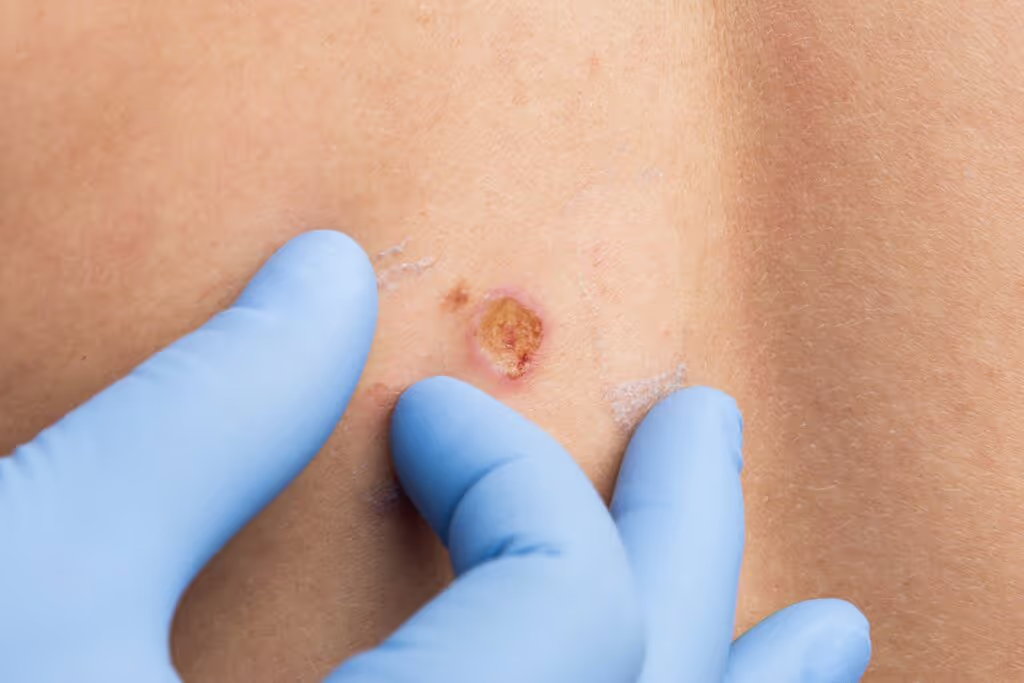
Accuracy hinges on demonstrating clear medical necessity by linking the correct ICD-10-CM code to each CPT code. Consider this common FQHC scenario: An established patient with type 2 diabetes presents for a scheduled follow-up. During the exam, the patient points out a new, concerning skin lesion, which the provider decides to biopsy.
The claim should be structured as follows:
- Line 1: CPT 99214-25 linked to ICD-10 E11.9 (Type 2 diabetes mellitus without complications). The Modifier 25 indicates the E/M service was distinct from the biopsy procedure.
- Line 2: CPT 11102 (Tangential biopsy of skin) linked to ICD-10 L82.1 (Inflamed seborrheic keratosis) or another code justifying the lesion removal.
- Line 3: HCPCS T1015 with Modifier CG to trigger the all-inclusive PPS payment for the encounter.
This structure clearly communicates that two separate services were medically necessary during a single encounter, ensuring proper adjudication and full reimbursement while maintaining a clean audit trail.
Ensuring Compliance and Financial Health
Mastering FQHC billing for medical visits requires a deep understanding of the interplay between the PPS encounter rate (T1015), specific service documentation (CPT E/M codes), and justification (ICD-10). Correctly applying modifiers like 25 and CG is not optional; it is fundamental to capturing earned revenue and preventing costly denials and audits. As payer policies and 2025-2026 regulations evolve, maintaining coding accuracy is paramount for the financial stability of any FQHC. By prioritizing precise, compliant coding practices, your center can secure the reimbursement necessary to continue providing invaluable care to your community.
FQHC Billing Essentials
- Bill Medicare/Medicaid encounters with HCPCS code T1015 to receive the PPS rate.
- Detail all services on the claim using specific CPT codes (e.g., 99213, 11102).
- Use Modifier 25 on an E/M code when a separate, significant procedure is performed on the same day.
- Ensure every CPT code is linked to an ICD-10 code that proves medical necessity.
- Apply Modifier CG to FQHC service lines to ensure proper payment processing under PPS.
Why Choose Us
FQHC billing isn't just a service line for us; it's a core specialty. Bonfire Revenue's experts understand the nuances of PPS, state-specific Medicaid rules, and the credentialing challenges you face. We go beyond simple claim submission to optimize your entire revenue cycle, ensuring you capture every dollar earned for the vital community care you provide. Partner with us to strengthen your financial foundation.