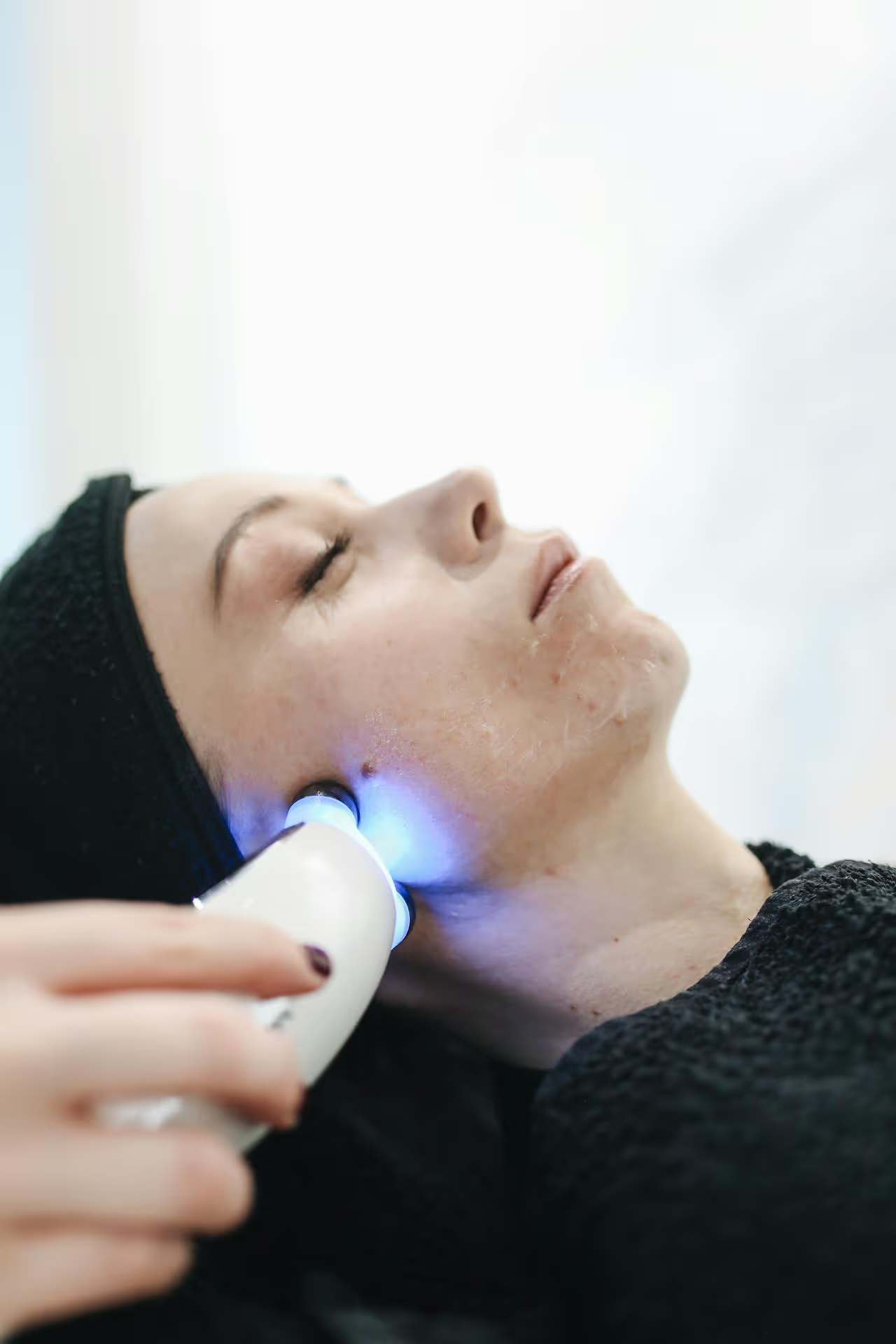


Laser treatments are a cornerstone of modern dermatology, offering powerful solutions for both medical and aesthetic conditions. However, this advanced technology brings significant billing complexities that can easily lead to claim denials and revenue loss. Payers maintain stringent policies, drawing a hard line between medically necessary and cosmetic procedures. Navigating this landscape requires a precise understanding of CPT codes, appropriate modifier usage, and ironclad ICD-10 linkage. This guide provides the clarity your practice needs to overcome these nuances and secure proper reimbursement.
Navigating CPT Codes for Laser Procedures
A common pitfall in laser billing is coding based on the technology used rather than the condition treated. Payers reimburse for the destruction of a lesion, not the method. Therefore, CPT code selection must be driven by the lesion's type, size, and quantity.
For destruction of benign lesions like warts or keratoses, the CPT series 17110-17111 is appropriate. For cutaneous vascular proliferative lesions, such as those treated with a Pulsed Dye Laser (PDL), the CPT series 17106-17108 applies. It's critical to note that procedures like laser hair removal often fall under the unlisted procedure code 17999 (Unlisted procedure, skin, mucous membrane and subcutaneous tissue). When using an unlisted code, comprehensive documentation, a detailed procedure report, and comparison to a similar CPT code are essential for payers to adjudicate the claim.
The Critical Role of Modifiers and ICD-10 Linkage
Modifiers and diagnosis codes tell the full story of a patient encounter. Modifier 25 is crucial when a significant, separately identifiable Evaluation and Management (E/M) service is performed on the same day as a laser procedure. For example, if a patient presents for a full-body skin check (E/M service) and a decision is made to treat a newly identified actinic keratosis with a laser, Modifier 25 appended to the E/M code signifies the distinct nature of the visit.
Equally important is the direct link between the CPT code and the ICD-10 code, which establishes medical necessity. Treating a hemangioma (ICD-10: D18.01) with CPT code 17106 presents a clear, medically necessary scenario. Conversely, using the same CPT code for cosmetic telangiectasias (ICD-10: I78.1) will likely result in a denial without documentation proving functional impairment, such as recurrent bleeding. Always consult the payer’s Local Coverage Determinations (LCDs) to confirm covered diagnosis codes for specific laser procedures.
Real-World Scenarios: Avoiding Common Denials
Scenario 1: Bundling Denial. A claim is submitted for CPT 99213-25 (E/M visit) and CPT 17110 (Destruction of benign lesions). The payer denies 99213 as bundled. Analysis & Solution: The denial likely occurred because the documentation failed to clearly separate the E/M work from the pre-operative work for the procedure. The medical record must show a distinct reason for the E/M, such as managing the patient's chronic psoriasis, which is separate from the evaluation of the benign lesion treated that day.
Scenario 2: Medical Necessity Denial. A claim for laser resurfacing (often billed with unlisted CPT 17999) for a traumatic scar (ICD-10: L90.5) is denied. Analysis & Solution: Payers are highly skeptical of laser resurfacing claims. Medical necessity must be proven beyond doubt. Successful claims require documentation detailing the scar's functional impact, such as causing contracture or persistent pain. Pre-authorization is almost always required, and photographic evidence should be included with the claim submission to substantiate the medical need over cosmetic preference.
Ensuring Reimbursement in Laser Dermatology
Maximizing reimbursement for dermatology laser treatments hinges on precision. Success is built on accurate CPT selection based on the lesion, not the laser; strategic use of modifiers like 25 and 59 to delineate services; and irrefutable ICD-10 linkage that satisfies payer-specific medical necessity policies. Proactively consulting LCDs and meticulously documenting every aspect of the encounter are non-negotiable. By mastering these billing and coding fundamentals, your practice can confidently navigate payer complexities, reduce denials, and secure the revenue you have rightfully earned.
Laser Billing Essentials
- Code by Lesion: Select CPT codes based on lesion type, size, or number, not the laser technology.
- Justify with Modifiers: Use Modifier 25 for separate E/M services and Modifier 59 for distinct procedures on the same day.
- Prove Medical Necessity: Link CPT codes to specific ICD-10 codes validated by the payer's LCDs.
- Detail Unlisted Codes: For CPT 17999, provide robust documentation, op-notes, and code comparisons.
- Segregate Services: Clearly differentiate and document medically necessary vs. cosmetic procedures before treatment.
Why Choose Us
Bonfire Revenue's dermatology experts go beyond simple claim submission. We audit your coding, manage payer-specific nuances, and stay ahead of 2025-2026 regulatory shifts to maximize your laser treatment revenue. Stop leaving money on the table due to correctable billing errors.


_0.659722055465341110000.png?generation=1767673122094668&alt=media)