

Cosmetic dentistry represents a high-value service line, yet it is a consistent source of revenue cycle friction due to claim denials. Payers automatically flag procedures perceived as "aesthetic" for non-payment, overlooking legitimate functional and restorative components. The key to overcoming these denials is not in changing the treatment, but in mastering the narrative through precise documentation and strategic coding. This article provides a blueprint for accurately billing cosmetic cases by establishing irrefutable medical necessity, ensuring you are compensated for complex, functionally-restorative work.
Defining Medical Necessity in Aesthetics
The fundamental challenge in cosmetic case billing lies in shifting the payer's perspective from "elective enhancement" to "medically necessary restoration." This requires a clinical narrative supported by diagnostic coding that goes beyond the surface-level CDT code. While a carrier sees D2962 (Veneer, porcelain/ceramic) and thinks "cosmetic," the supporting diagnosis tells the true story. Is the veneer correcting a fractured tooth? Then the claim must be linked to a diagnosis like S02.5XXA (Fracture of tooth, initial encounter).
Every claim must answer the "why" behind the procedure. Documentation must clearly detail functional impairments such as difficulty with mastication, structural integrity compromised by trauma or decay, or prevention of further dental deterioration. Without this justification, even the most expertly performed procedure will be denied as a non-covered service.
Strategic CDT and ICD-10 Linkage
Accurate reimbursement hinges on the precise linkage between the service rendered (CDT code) and the patient's diagnosis (ICD-10-CM code). Simply listing codes is insufficient; they must tell a cohesive and logical clinical story, supported by narrative reports, intraoral photos, and radiographs.
Consider these common scenarios:
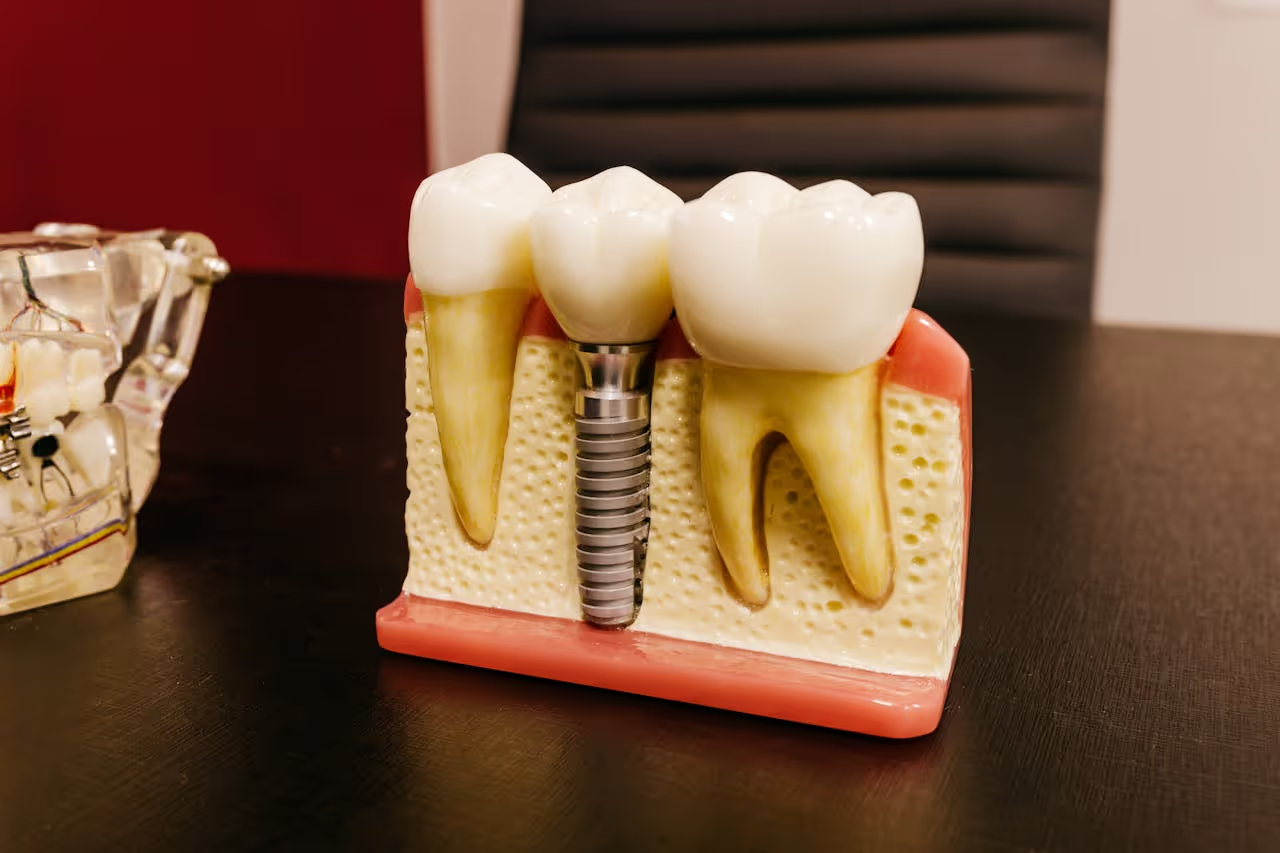
- Dental Implants: A claim for D6010 (Surgical placement of implant body) can be denied as cosmetic. However, when replacing a tooth lost due to severe, untreatable periodontal disease, linking it to K05.31 (Chronic periodontitis, localized) establishes a clear medical need.
- Crowns for Attrition: A full mouth rehabilitation using crowns like D2740 (Crown - porcelain/ceramic) may be flagged. By linking the treatment to diagnoses of K03.0 (Excessive attrition of teeth) and G47.63 (Sleep related bruxism), you demonstrate the procedure is necessary to restore lost vertical dimension and prevent further pathological wear.
This level of specificity is non-negotiable, especially as payer policies for 2025-2026 are projected to enforce even stricter documentation requirements for high-cost dental procedures.
Case Study: From Cosmetic Denial to Medical Approval
A patient presents with congenitally missing lateral incisors, resulting in a malocclusion and compromised biting function. The proposed treatment is two dental implants and crowns. The initial pre-authorization, coded simply with D6010 and D6058 (Abutment supported porcelain/ceramic crown), is denied as "cosmetic" and for having a "missing tooth" exclusion clause.
Bonfire Revenue's approach involves resubmitting with a detailed appeal. The claim is reframed to highlight the functional deficit. We link the procedure codes to K00.0 (Anodontia) to establish the congenital nature of the condition and K07.4 (Malocclusion, unspecified) to document the functional impairment. The narrative report, supported by photographic evidence and a description of the patient's difficulty with incising food, proves the treatment is restorative, not aesthetic. This strategic repositioning successfully overturns the denial by demonstrating the procedure's primary purpose is to restore normal oral function.
Securing Your Cosmetic Case Revenue
Successfully billing for cosmetic dentistry is an exercise in clinical and administrative precision. Reimbursement is not about finding loopholes but about building an undeniable clinical case for medical necessity. By meticulously documenting functional impairments, linking specific CDT procedure codes to corroborating ICD-10 diagnoses, and crafting compelling narrative reports, your practice can transform cosmetic-related denials into reliable revenue. This proactive, evidence-based approach is the definitive strategy for navigating complex payer policies and ensuring fair compensation for your highest-value services.
Coding for Reimbursement
- Prove Medical Necessity: Link every CDT code to a specific ICD-10 diagnosis that justifies the procedure's functional purpose.
- Document Function: Clearly articulate how the treatment restores function (e.g., mastication, occlusion) in your clinical notes and narrative reports.
- Leverage Visuals: Use intraoral photos and radiographs as objective evidence to support your clinical narrative and justify treatment.
- Anticipate Payer Scrutiny: Prepare for stricter 2025-2026 documentation requirements by building airtight claims now.
Why Choose Us
Bonfire Revenue specializes in the complexities of high-value dental billing. Our experts understand how to build irrefutable, evidence-based claims that turn cosmetic-related denials into approvals. We navigate payer policies so you can focus on clinical excellence.