

Critical Access Hospitals (CAHs) are the backbone of rural healthcare, and the Emergency Department (ED) is often the primary point of care. However, the unique reimbursement models and operational constraints of CAHs create significant billing and coding challenges. Inaccurate coding for ED visits not only jeopardizes revenue but can also trigger audits and compliance issues. Mastering the nuances of Evaluation and Management (E/M) levels, modifier application, and diagnosis-to-procedure linkage is essential for the financial stability and continued service of any CAH.
Navigating E/M Coding for CAH Emergency Departments
The foundation of ED billing lies in the correct assignment of E/M CPT codes 99281-99285. Since the 2023 E/M guideline updates, level selection for ED services is based exclusively on the complexity of Medical Decision Making (MDM). Unlike office visits, time is not a determining factor for coding ED encounters. This places immense pressure on clinical documentation to accurately reflect the three core elements of MDM:
- Number and Complexity of Problems Addressed: The severity and nature of the presenting problem(s).
- Amount and/or Complexity of Data to be Reviewed and Analyzed: Review of tests, orders for new tests, or discussion with other healthcare professionals.
- Risk of Complications and/or Morbidity or Mortality of Patient Management: The risk associated with the patient's condition, diagnostic procedures, and treatment options.
For CAHs, where providers often manage a wide acuity range with limited resources, meticulously documenting each MDM element is critical to justifying higher-level E/M services like 99284 or 99285 and ensuring appropriate reimbursement.
The Critical Role of Modifiers and Revenue Codes
Accurate ED billing extends beyond the E/M code. Modifiers are essential for communicating specific circumstances to payers. Modifier 25 is paramount in the ED setting, used to indicate a "Significant, Separately Identifiable Evaluation and Management Service by the Same Physician or Other Qualified Health Care Professional on the Same Day of the Procedure or Other Service." It is correctly appended to an E/M code when a distinct evaluation is performed beyond the usual pre-operative and post-operative care associated with a minor procedure performed on the same day.
For example, a patient presents with a deep 4cm laceration on their forearm (ICD-10: S51.812A). The physician performs a problem-focused history and exam to rule out nerve damage or foreign bodies (a significant E/M service) before proceeding with a layered closure (CPT: 12032). In this case, the E/M code (e.g., 99283) would be billed with Modifier 25 to signify it was a separate service from the repair itself. On the facility side (UB-04), this must align with the appropriate revenue code, typically 0450 for the ED visit, to avoid payer denials.
Ensuring ICD-10 and CPT Compatibility
The ultimate validation of an ED claim is medical necessity, which is established by linking the correct ICD-10-CM diagnosis code to the CPT procedure and E/M codes. The diagnosis must logically support the intensity of the services rendered. A low-acuity diagnosis cannot justify a high-level E/M code. Payers use sophisticated algorithms to flag mismatches between diagnosis and service level, leading to automatic denials.
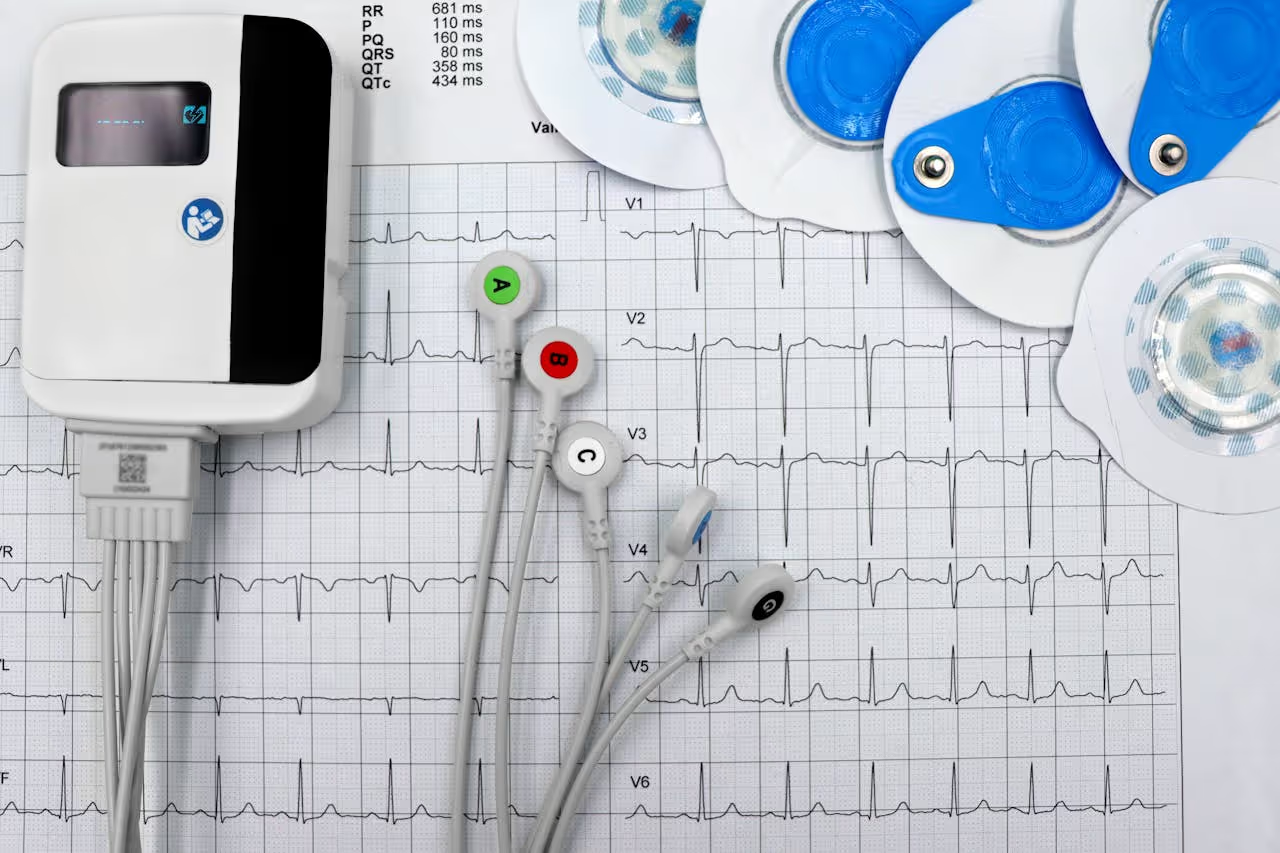
Consider a patient presenting with acute, crushing chest pain (ICD-10: R07.82). The ED provider performs a comprehensive workup, including an EKG interpretation (CPT: 93010), chest X-ray, and extensive lab analysis, leading to a diagnosis of acute myomyblog-cardial infarction (ICD-10: I21.9). The high-complexity MDM involved in this workup clearly supports a high-level E/M code like 99285. The documentation must clearly trace the path from the presenting symptom to the definitive diagnosis and the management plan, creating an unbreakable chain of medical necessity that satisfies payer scrutiny.
Optimizing CAH Revenue Through Coding Precision
For Critical Access Hospitals, financial health is directly tied to billing accuracy. Thriving in the current healthcare landscape requires a proactive and expert approach to ED revenue cycle management. This means mastering E/M coding based on MDM, applying Modifier 25 with precision, and ensuring every claim is supported by a clear link between ICD-10 and CPT codes. By focusing on detailed documentation and coding expertise, CAHs can overcome common billing hurdles, secure the reimbursement they have earned, and continue to provide essential emergency care to their communities.
ED Coding Essentials for CAHs
- Base ED E/M levels (99281-99285) exclusively on Medical Decision Making (MDM).
- Use Modifier 25 correctly for separate E/M services performed on the same day as a procedure.
- Ensure ICD-10 codes precisely reflect the patient's condition to justify the CPT codes billed.
- Accurate clinical documentation is the foundation of compliant and optimized reimbursement.
Why Choose Us
Bonfire Revenue specializes in the unique RCM challenges of Critical Access Hospitals. We understand the nuances of Method I and Method II billing, cost-based reimbursement, and the specific payer rules that impact rural facilities. Our certified experts ensure compliance and maximize revenue, allowing you to focus on vital patient care.